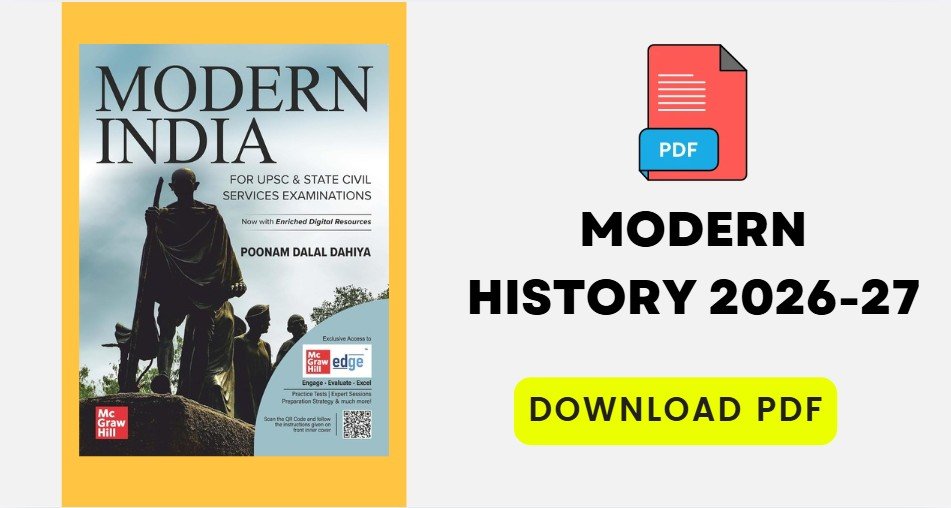
Preparing Modern Indian History for UPSC can feel a little confusing at first. The syllabus is not necessarily difficult, but there are so many events, movements, personalities and dates that it is easy to lose track of how everything fits together.
Modern India by Poonam Dalal Dahiya is designed with this problem in mind. The book is presented specifically for UPSC and State Civil Services examinations and focuses on the important developments that shaped modern India.
Rather than treating history as a collection of isolated facts, the book aims to help students understand the sequence of events and the changes that took place over time.
📚 What does Modern India cover?
The book begins with the British Conquest of India and then moves through the major political and social developments that followed.
The major areas covered include:
- British expansion and conquest in India
- Changes in administration and governance between 1757 and 1857
- Early Indian responses, reforms and rebellions
- The Revolt of 1857
- Growth of Indian nationalism
- Moderates and Extremists
- Indian politics during the First World War
- The emergence of Mahatma Gandhi
- Developments during 1922–27
- Nationalist politics from 1927 to 1937
- The growth of communalism
- The road towards Independence and Partition
The sequence is particularly important for students because modern Indian history becomes much easier when events are studied chronologically.
🇮🇳 Why Modern Indian History matters for UPSC
Modern History is one of those areas where a student can score well with the right kind of preparation.
Questions may appear straightforward, but UPSC often tests whether you actually understand the background of an event rather than simply remembering its date.
For example, while studying the national movement, it is useful to understand why a particular movement started, what led to its withdrawal, how the British government responded and what happened afterwards.
This way of studying also becomes helpful for Mains, where simply writing facts is not enough. You need to connect causes, events and consequences in a logical manner.
✍️ A book that can help build conceptual clarity
One thing I liked about the book's approach is that it is not presented as a simple list of historical events. The subject is divided into logical stages, beginning with British expansion and gradually moving towards nationalism, mass movements and Independence.
For someone revising Modern History for the first time, this kind of progression can make the subject considerably easier to follow.
At the same time, aspirants should not try to memorize every line. A better approach is to first understand the story of the period and then come back for factual revision.
🎯 Useful for Prelims as well as Mains
Modern India has relevance for both stages of the Civil Services Examination.
For Prelims, students need to be comfortable with facts relating to important acts, movements, organizations, personalities, sessions and historical developments.
For Mains, the focus shifts towards understanding issues such as the development of nationalism, the nature of British rule, social reform, the freedom movement and the factors responsible for Independence and Partition.
So while reading the book, I would recommend maintaining two separate perspectives:
Prelims → Facts, chronology and important events
Mains → Causes, impact, significance and different perspectives
That small change in the way you read can make revision much more productive.
📝 How I would recommend studying this book
Don't try to finish Modern History in one sitting. It is much easier to retain when studied in small sections.
A simple strategy would be:
1. Read the chapter normally
Focus on understanding what happened rather than memorizing everything.
2. Make a short timeline
Put major events in chronological order.
3. Connect related events
For example, don't study different national movements as completely separate topics. Try to understand how one development influenced the next.
4. Solve previous-year questions
After completing a topic, check UPSC PYQs. This will tell you what the examination actually expects from that topic.
5. Revise repeatedly
History becomes easier with every revision. The second and third readings are usually much faster than the first.
📖 Our Review
Modern India by Poonam Dalal Dahiya looks like a useful resource for aspirants who want to study Modern Indian History in a structured manner for UPSC and State Civil Services examinations.
Its biggest advantage is the way the subject is organized around the major stages of India's modern history—from British conquest and the developments of the colonial period to nationalism, the freedom struggle and Independence.
The book also mentions enriched digital resources, which can add another dimension to preparation for students who prefer combining traditional reading with digital learning.
However, I would not recommend relying on any single history book for UPSC preparation. Use this book as your main reading source if it suits your study style, and supplement it with NCERTs, previous-year questions and regular revision.
Final Verdict
If Modern Indian History is currently one of the weaker areas of your UPSC preparation, this book is worth considering as a dedicated study resource. The important thing is not simply to complete the chapters, but to understand the chain of events and revise it multiple times.